2025 Global Hiring Report
by Pebl
In a time of turbulent economies, shifting H-1B regulations, and an ever-changing geopolitical landscape, we surveyed 400+ leaders to see how they’re managing international teams, navigating compliance, and adjusting strategy in real time.
What you need to know:
International hiring is growing
Nearly 1 in 2 respondents expect most hiring will be international by 2027.
Companies are already getting ready
44% of respondents plan to increase international hiring by H1 2026.
AI isn’t the only agent of change
40% believe global hiring will be default by 2028; only 17% say AI will be.
American labor is getting pricier
It’s driving a shift to automation and accelerating international hiring.
Domestic hiring is slowing
Growth opportunities abroad and domestic labor shortages are why.
Compliance remains a blocker
Regulatory barriers continue to stall international hiring plans.
Global hiring has shifted from exploratory to essential.
Global hiring is accelerating across industries and geographies. Within months, most companies will be bringing in talent from beyond their borders. Many expect international workers to make up half or more of their workforce in just two years.
The 2025 Global Hiring Report shows how the best teams are hiring across borders with less friction and more control.
Leaders expect international hiring to grow.
Nearly half expect a majority of new hires to be abroad in 24 months.
What it means for business
Global hiring is no longer speculative. 71% of leaders expect at least some hires abroad within 6 months. That jumps to 86% within 2 years. And when asked when half or more of all hires will be international, nearly 1 in 2 respondents, 48%, expect by 2027.
Leaders expecting at least some hiring to be abroad:
71%
within 6 months
86%
within 24 months
Leaders expecting half or more hiring to be abroad:
48%
within 24 months
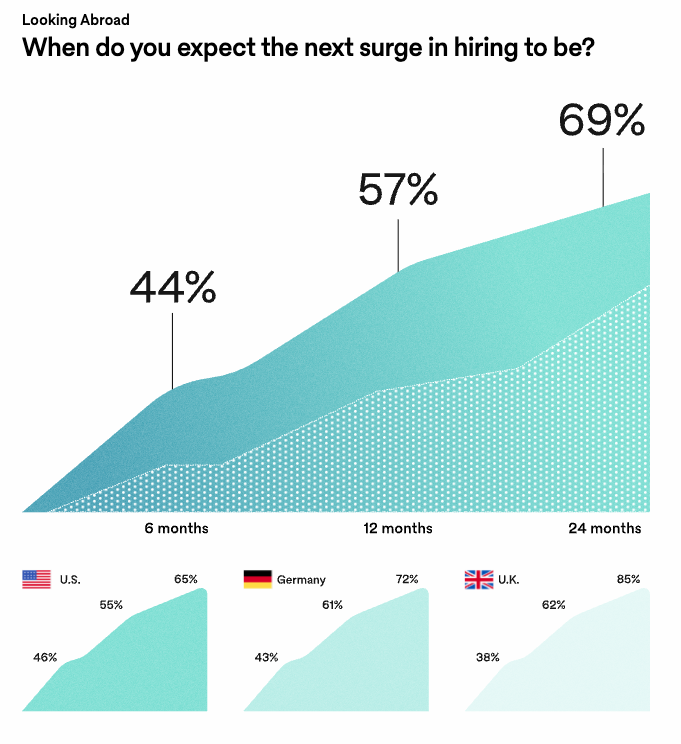
Companies are increasing global hiring over the next two years.
The next global hiring surge is already here.
What it means for business
Momentum is building quickly, with expectations for increased global hiring rising from 44% in 6 months to nearly 70% in two years.
AI is not changing the global job market the way it seems.
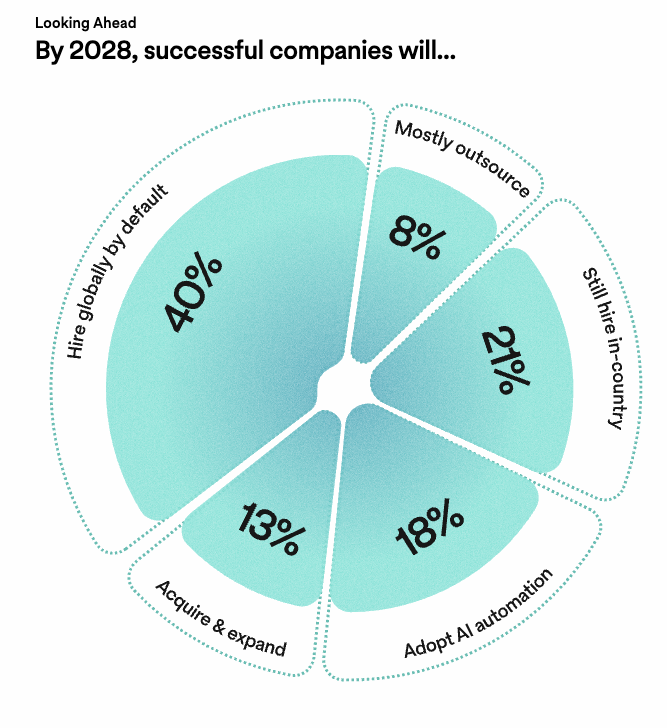
Global hiring and even in-country hiring beat projected AI adoption.
What it means for business
By 2028, 40% of respondents believe successful companies will be hiring globally by default.
21% of respondents said successful companies would still be hiring in-country.
Only 17% said they’d be automating tasks with AI instead of expanding headcount.
AI isn’t transforming work—global hiring is.
Today, 55% already say global hiring is core to long-term strategy.
But what’s making hiring managers look abroad?
Behind the acceleration are economic realities leaders can’t ignore.
U.S. wage inflation is pushing hiring managers to find other ways to build their workforces besides hiring American.
The high cost of American labor
What it means for business
Business leaders aren’t hiring globally just for growth, they’re being driven by cost pressures, skill shortages, and compliance realities.
Global hiring has shifted from optional to inevitable.
23%
say it’s slowing or outright freezing domestic hiring
51%
say it’s accelerating international hiring
60%
say it’s driven a shift toward automation/AI
There’s high opportunity abroad.
Businesses are finding proactive reasons to hire internationally, too
What it means for business
Raised U.S. wages aren’t the only thing sending employers beyond their own borders. Nearly half say growth opportunities abroad are driving international hiring, with U.S. labor costs and demand for AI skills coming close behind it.
Top reasons companies are going international
49%
Growth opportunities
49%
Rising U.S. labor costs
44%
Demand for AI skills
38%
Domestic labor shortages
35%
Tax and compliance advantages abroad
Compliance issues are slowing—or stopping—expansion.
Outside rising costs and more opportunity, compliance hurdles are also driving international hiring.
What it means for business
When hiring and/or expansion is delayed or cancelled, a majority say it’s been due to compliance hurdles—and a third say it’s happened more than once.
Reasons why expansion stalls:
87%
Report compliance hurdles
33%
Report it’s happened twice or more
Of all HR and Finance leaders surveyed, 87% say hiring abroad just makes good economic sense.
Are you hiring for yesterday, or tomorrow?
Global teams don’t just fill roles, they increase agility and open opportunity.
The data shows which way the winds are blowing—now it’s up to businesses to turn their sails to catch them. Dispersed global teams can deliver sharp cultural insight and resilience in the face of adversity. Companies that act now will gain an edge, while those that wait risk talent debt.

Companies are no longer treating global hiring as a backup plan, it’s becoming the default strategy.
Francoise Brougher
CEOYour competitors are hitting the gas. Are you?
The companies that will win tomorrow are making plans today. Now is the time to seek out and lock down the global talent that will be fought over in the coming years.
Get the full insights behind this global hiring report and what it means for your strategy.
Download the full report
We care about your privacy. By submitting this form, you will receive the requested information, as well as occasional related business insights from Pebl. You can unsubscribe at any time. For details, view our Privacy Policy.
How we conducted the 2025 Global Hiring Survey
This inaugural survey of 423 HR and Finance leaders at the director level and above was conducted online by Researchscape International for Pebl between July 29 and August 20, 2025. Respondents, based in the U.S., U.K., and Germany, worked at companies with 100–999 employees and $25–49M in revenue, each with at least some in-country staff. Results were weighted to be representative.