200 Kilometers Across the Namib: What Our CPTO Learned Running Through a Desert
Chien-Liang Chou, Pebl's Chief Product & Technology Officer, ran 200km across the Namib Desert over seven days. Here's what the sand, heat, and silence taught him.
Where performance meets possibility
See how Pebl helps you hire, pay, and manage talent anywhere.
Seven days. 200 kilometers. One desert.
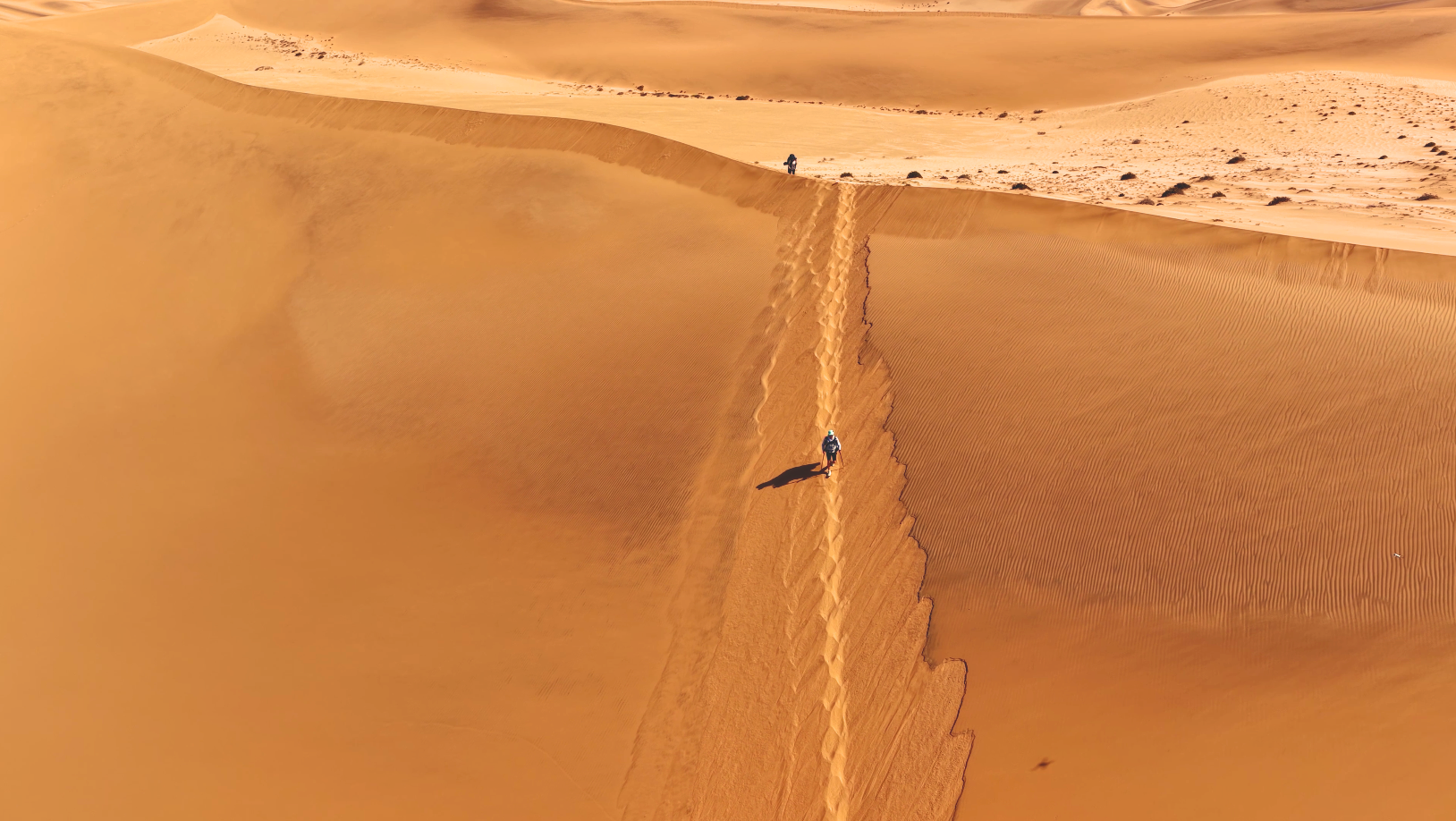
Earlier this year, Chien-Liang Chou, Pebl's Chief Product & Technology Officer, lined up at the start of the Namib Race 2026: a seven-day, 200-kilometer (roughly 124-mile) self-supported footrace across the sand dunes, mountains, and valleys of the Namib Desert. It was his first time racing in Namibia, and by his own account, the desert did not go easy on him.
Here is his account of the week.
Arriving in Namibia
Before the first footstep, there was the place itself.
"I'd never raced in Namibia before," Chien-Liang says. "The landscape is unlike anywhere I've been. But what stayed with me just as much were the people and the culture. There's a warmth there that you feel immediately."
That first impression mattered more than he expected. Over the following week, the landscape would test him constantly. The people would be the reason he kept going.
Stage one: "Completely toasted"
The Namib does not offer a gentle introduction.
"After stage one, I was completely toasted," he says. "Like a barbecue chicken."
The heat was relentless, the kind that does not let up when you slow down. Plenty of runners have a rough first day in the desert. The question is what you do on day two.
For Chien-Liang, the answer came down to three unglamorous things: sleep, hydration, and timing. Enough rest to actually recover overnight. Disciplined drinking rather than reactive drinking. And the gift of the Namib's cooler morning fog, which rolls in off the Atlantic and buys runners a few merciful hours before the sun takes over.
By the second and third stages, he had found his rhythm. The desert had not gotten easier. He had gotten better at reading it.
Moon Valley and the mountains
The course itself was the reward.
Runners traversed Moon Valley, a stretch of eroded, otherworldly terrain that looks less like Earth and more like something photographed by a rover. Then came the mountains: steep, consecutive climbs that arrived one after another with no flat ground in between to recover on.
"You'd crest one and see the next one waiting," Chien-Liang says. "There's a moment where you just have to accept that this is the next several hours of your life."
The people at the checkpoints
Ask most ultra runners what got them through, and they rarely say their training plan.
"The volunteers and the staff at the checkpoints were incredible," Chien-Liang says. "You arrive somewhere between exhausted and finished, and there's someone there cheering, handing you water, telling you you've got this. It resets you. I don't think people outside the sport understand how much that matters."
Every checkpoint was a small reminder that a solo endurance event is not actually solo.
The long stage
Then came the part everyone talks about: the long stage, 80 kilometers, with 78 kilometers (roughly 47 miles) covered in a single day.
The heat was constant. The fatigue compounded. And by that point in the week, the dehydrated race meals that had seemed perfectly acceptable on day one had become genuinely hard to face.
His coping strategy was refreshingly simple. Dump water over his head to stay cool. And keep his mind fixed on two things waiting at the end of the week: real food, and ice cream.
"That's it," he laughs. "That's the whole mental strategy. Real food and ice cream."
It is a useful reminder that endurance is rarely about grand motivation. It is usually about finding something small enough to be believable and holding onto it.
Crossing the finish line
The finish line brought something other than relief.
"Pushing your body that hard strips everything else away," Chien-Liang reflects. "There's no email, no roadmap, no meetings. Just you, the ground in front of you, and the next checkpoint. It resets your mind as much as it exhausts your body."
Seven days in the desert gave him something rarer than a finisher's medal: time to reconnect with nature, and time to sit with the bigger questions. What is the purpose of all this? Where am I actually headed? What matters enough to keep going toward?
Most of us do not get many uninterrupted hours to think about that. He got seven days of them.
What the desert teaches
There is a reason stories like this resonate at a company like Pebl, where teams are spread across continents and time zones.
Hard things are done incrementally. Checkpoint to checkpoint. The conditions rarely improve, so you adapt instead. And the encouragement of the people around you, even the ones you have only just met, is what carries you further than willpower ever will.
Congratulations, Chien-Liang. We hope the ice cream was worth it.
Draft compliant contracts in minutes
Tell us where you are hiring and we will map the fastest compliant path, all through one point of contact.